Do Veneers Damage Your Natural Teeth?
This is the right question to ask, and it deserves a straight answer rather than reassurance. Conventional veneers do involve removing a layer of your tooth, that removal is permanent, and no veneer ever puts it back.
What the research adds is more useful than a yes or no: how much enamel is kept is the single strongest predictor of how long a veneer lasts. The thing patients worry about and the thing that determines success turn out to be the same thing.
What a veneer is, and what preparation means
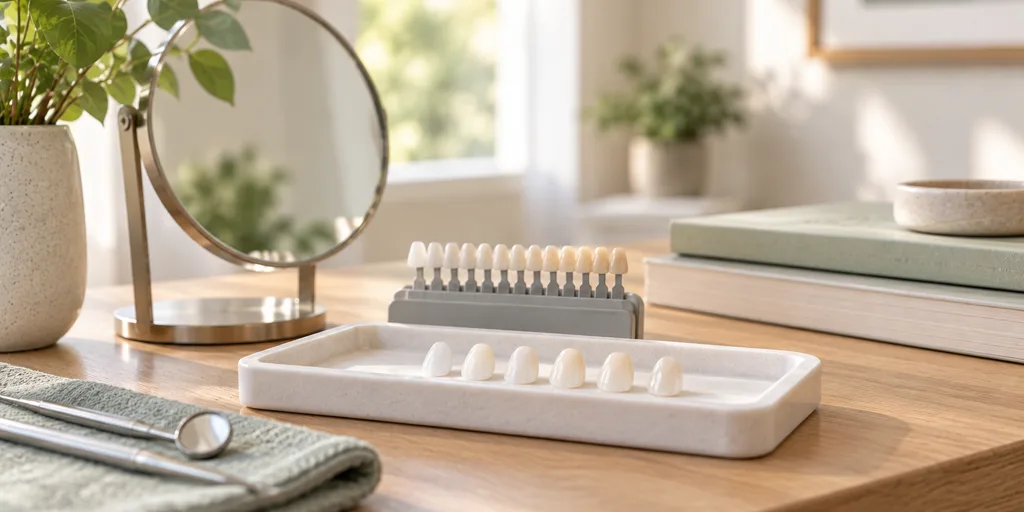
A veneer is a thin shell, usually porcelain or a glass ceramic, bonded to the front of a tooth to change its shape, shade or alignment.
For it to sit flush rather than proud, space usually has to be made. That means removing a thin layer from the front of the tooth, typically within the enamel. Enamel does not regenerate. Once it is reduced, the tooth is committed to being covered, and replacing a veneer later means replacing it, not going back.
That is the honest cost of the treatment, and it should be weighed before anything is prepared rather than afterwards.
The evidence on enamel, and why it is the whole story
Long-term studies of porcelain veneers point the same way with unusual consistency.
Veneers whose preparation stays entirely within enamel have been reported with survival around 99 percent, compared with roughly 94 percent where enamel remained only at the margins. Ten-year cumulative survival for porcelain laminate veneers sits in the region of 95 percent overall.
The sharpest finding concerns what happens when preparation goes through the enamel into the dentin beneath. Analysis has found veneers bonded to dentin, or with margins ending in dentin, to be roughly ten times more likely to fail than those bonded to enamel.
The reason is adhesion. Enamel bonds predictably and durably. Dentin is wetter, more variable and a less reliable surface to bond to. A veneer is only as good as what it is stuck to.
Reviews of minimal and no-preparation approaches report survival in the same high band, with no-preparation veneers averaging around 97 percent against roughly 92 percent for conventional preparations.
What this means for you
Read together, the research says something practical: the less of your tooth removed, the better the veneer is likely to do. Preserving enamel is not a compromise made to keep patients comfortable. It is the clinically stronger route.
That reframes the conversation. The question is not only "will this damage my teeth" but "how much preparation does my case actually need", and those have the same answer.
Minimal preparation is not possible for everyone. Teeth that are significantly out of position, badly discoloured or already heavily restored may need more reduction to get an acceptable result. What matters is that the trade is made deliberately and explained, rather than defaulted to.
Questions worth asking before anything is prepared
- How much enamel are you removing, and will any margin end in dentin? This is the question the research says matters most.
- Is my case suitable for a minimal or no-preparation approach? If not, why not.
- Can I see a mock-up first? A trial of the proposed shape, done before any tooth is touched, is standard careful practice.
- What happens when this veneer eventually needs replacing? Not if. Plan for it.
- Is there an option that does not involve preparation at all? Whitening, bonding or orthodontics solve some of the problems people bring to veneers, without the irreversible step.
That last one deserves weight. If the issue is colour alone, whitening changes nothing about the tooth structurally. If the issue is position, moving the teeth treats the cause rather than covering it. We looked at what whitening does and does not do to enamel in is teeth whitening safe for your enamel.
Looking after them
A veneer does not decay, but the tooth underneath and the gum around it very much can, and the margin where veneer meets tooth is the vulnerable line. Cleaning matters as much as it did before, arguably more.
Grinding is the other risk. Ceramic is strong under compression and less forgiving of sustained lateral force, so a grinding habit should be managed rather than mentioned in passing. If you clench at night, say so.
You can read more about how veneers are planned and fitted at the clinic, or about the wider smile makeover options if you are still deciding what problem you are solving.
Frequently asked questions
Do veneers ruin your teeth?
Conventional veneers permanently remove a layer of enamel, which does not grow back, so the tooth will always need covering afterwards. Whether that counts as ruin depends on how much is removed and how well the result is maintained. The research is clear that keeping preparation within enamel gives much better long-term outcomes.
Is the enamel removal reversible?
No. Enamel does not regenerate. This is the main reason to be certain about the decision before treatment starts rather than after.
Are no-preparation veneers better?
Where a case suits them, reviews report survival at least as good as conventional veneers and often slightly better. They are not suitable for every case, particularly where teeth are significantly out of position or need substantial shape change.
How long do veneers last?
Ten-year survival for porcelain laminate veneers is reported at around 95 percent in systematic reviews, and higher where preparation stayed within enamel. Individual results vary with bite, habits and maintenance.
What happens when a veneer fails?
It is usually replaced. Because the underlying tooth was prepared, going back to an uncovered natural tooth is not normally an option, which is worth understanding as a long-term commitment rather than a one-off treatment.
Can I whiten my teeth after having veneers?
Whitening does not change the shade of ceramic. Any whitening is normally done before veneers are made, so the shade can be matched to the teeth you intend to keep.
Individual results vary. This article is general information, not a diagnosis or treatment plan.
To talk through whether veneers are the right answer for your case, call the clinic on +91 94540 59725 or message on WhatsApp at +91 72900 53530, Monday to Saturday, 10 am to 2 pm and 5 pm to 8 pm.