
How Long Do Braces and Aligners Actually Take?
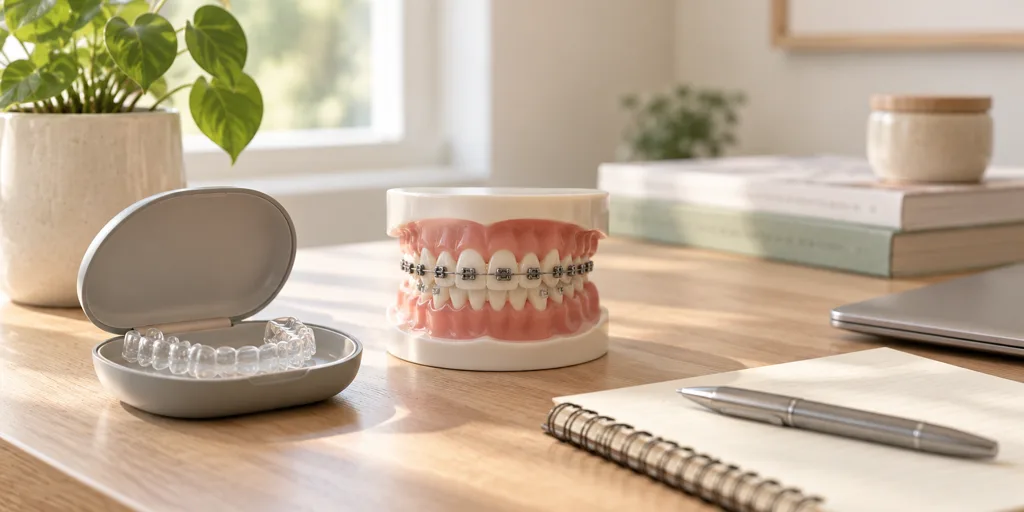
Almost everyone asks this before they ask anything else, and almost every answer they get is a range wide enough to be useless. The honest version is more interesting than a number, because the thing that decides how long your treatment takes is mostly not the appliance.
Typical orthodontic treatment in published trials runs somewhere between about 14 and 27 months. That is a real range from real studies, and where you fall in it depends far more on your teeth than on whether you choose braces or aligners.
What the research actually found
Trials comparing clear aligners with fixed braces do not agree with each other, and that disagreement is the most useful thing about them.
One randomised trial reported aligners finishing faster, at around 21 months against roughly 27 months for braces. Another reported the opposite, with aligners at about 18 months and braces at around 14. A third put aligners at around 18 months and braces at 22.
When well-run studies point in opposite directions, it usually means the variable being tested is not the one that matters most. Here, that variable is the case. Researchers looking across these studies attribute the inconsistency to differences in the type of bite problem being treated and the system being used.
So if someone quotes you a confident duration for aligners versus braces in general, rather than for your mouth in particular, they are quoting a preference rather than a finding.
What genuinely changes the timeline
How far the teeth have to move
Mild crowding and a serious bite discrepancy are not the same job. Closing a large space, correcting an overbite, or rotating a stubborn tooth all take time that straightening a slightly crooked front tooth does not.
What kind of movement is needed
This is where the two appliances genuinely differ. Research comparing them finds aligners do well at moving individual teeth in a controlled way, while fixed braces are generally better at controlling tooth angulation, settling the bite into good contact, and holding the result.
That is not an argument for either one. It is the reason an orthodontist recommends one over the other for a specific case, and why the recommendation may not match what you had in mind.
Whether you wear them
With fixed braces, this is largely out of your hands, which is part of their appeal. With aligners it is entirely in your hands. Aligners are typically worn for the great majority of the day and removed only for eating and cleaning, and a course that is worn part-time does not simply take proportionally longer. It can stop tracking altogether, which means new trays and lost months.
If you already suspect you would not wear them consistently, that is worth saying out loud at the consultation. It is a legitimate reason to prefer fixed braces.
Your age and your biology
Teeth move through bone, and bone responds at its own pace. Adults often take a little longer than teenagers for comparable movement. This is not a reason to avoid treatment as an adult, but it is a reason not to benchmark yourself against a fifteen year old.
Appointments kept
Every missed adjustment or delayed tray change is time added, and it accumulates quietly. This is the single most controllable factor on the list.
Retainers: the part nobody counts
Treatment time is usually quoted as the time in braces or aligners. It is not the time until you are finished thinking about it.
Teeth drift back. Retention is what prevents that, and the research comparing appliances specifically notes retention as an area where the way a case finishes matters. Retainers are not an optional extra at the end, they are the thing that protects everything the previous eighteen months bought.
Ask at the start what the retainer plan is and how long it runs. An answer of "for as long as you want the teeth to stay where they are" is honest rather than evasive.
Getting a real estimate for your case
A meaningful timeline comes after an orthodontic examination with records, not from a photograph or a range on a website. That assessment is also where you find out whether your case is one where the appliance choice is genuinely open or one where the clinical answer is fairly clear.
If you are still weighing the two, we compared them in more detail in braces or aligners in Indirapuram, and you can read about how aligner treatment is planned at the clinic.
Frequently asked questions
How long do braces usually take?
Published trials report averages in the region of 14 to 27 months depending on the study and the type of case. Your own estimate has to come from an examination, because the amount and type of movement needed is what drives it.
Are aligners faster than braces?
Not reliably. Some trials find aligners finish sooner, others find the reverse. The differences are attributed to the type of bite problem being treated rather than to the appliance itself.
What makes treatment take longer than expected?
Missed appointments, delayed tray changes, aligners not worn for enough hours a day, and cases that turn out to need more movement than first appeared. The first three are within your control.
Can I speed it up?
Mostly by removing the delays: keep appointments, change trays on schedule, and wear aligners for the hours you were told. Rushing tooth movement beyond what the biology allows is not a shortcut, it is a risk to the roots and the gum.
Do I have to wear a retainer forever?
Teeth have a tendency to drift for life, so retention is a long-term commitment rather than a final appointment. Your orthodontist will set a plan that usually reduces in intensity over time rather than stopping.
Will treatment take longer because I am an adult?
Often slightly, because bone remodels more slowly with age. It is a difference of degree, not a barrier, and plenty of adult treatment runs to a normal timeline.
Individual results vary. This article is general information, not a diagnosis or treatment plan.
For an assessment of your own case, call the clinic on +91 94540 59725 or message on WhatsApp at +91 72900 53530, Monday to Saturday, 10 am to 2 pm and 5 pm to 8 pm.