
What Actually Happens During Dental Implant Surgery
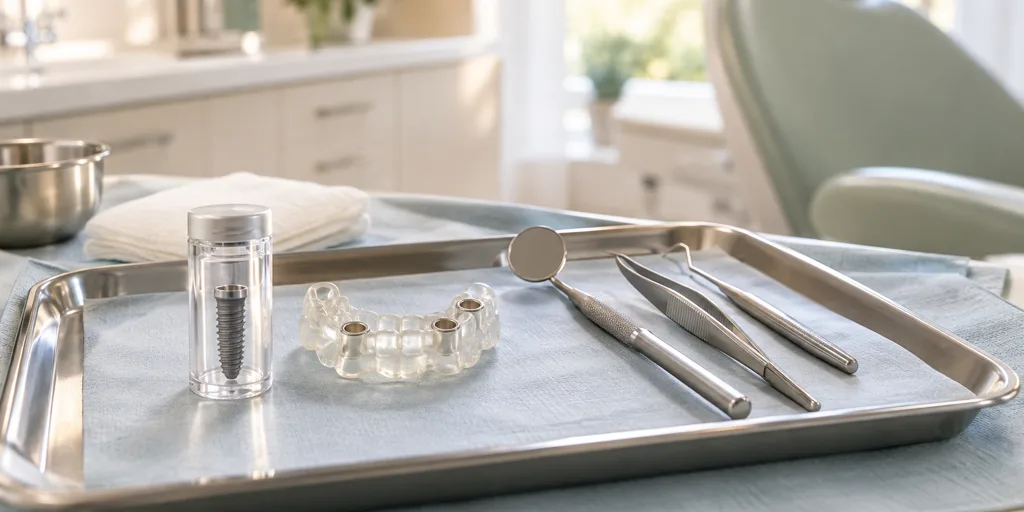
Most people agreeing to an implant have a reasonable idea of the result and almost no idea of the appointment. That gap is where the anxiety lives. This is what the day actually involves, what you will feel, and what happens in the months between the implant going in and the tooth going on.
The short version: implant placement is usually done under local anaesthetic, the appointment often runs around 90 minutes, and the part most people dread, the drilling, is something you hear rather than feel.
Before the day: planning is most of the work
The surgery itself is short. The planning is not, and it is what separates a straightforward case from a complicated one.
Your dentist needs to know how much bone you have, what shape it is in, and where the nerves and sinuses sit relative to the planned position. That usually means a scan rather than a standard X-ray, because an implant decision is three-dimensional and a flat image cannot show width.
This stage is also where a dentist may tell you that you are not ready yet. Active gum disease, uncontrolled diabetes or insufficient bone volume all change the plan, usually by adding a step rather than ruling the implant out. If that applies to you, treatment order changes. You can read more about how implants are planned and placed at the clinic.
The appointment itself
Anaesthetic
Implants are normally placed under local anaesthetic, the same class of injection used for a filling. You are awake and able to talk to the dentist throughout. The area is numb, not the rest of you.
People who find dental treatment difficult should say so at the planning stage rather than on the day, because sedation, where it is appropriate and available, is something that has to be arranged in advance.
Opening the gum
Once the anaesthetic has taken, the gum over the site is lifted back so the dentist can see the bone directly. It sounds worse than it feels. This is the step that makes the rest of the procedure precise, because the dentist is working on bone they can see rather than bone they are guessing at.
Preparing the site
A channel is shaped in the bone, widening in stages rather than in one go. The drilling is slow and heavily irrigated with water, because bone is living tissue and overheating it is the thing that stops an implant integrating.
This is the part patients report as the strangest, not the worst. You feel pressure and vibration, and you hear it clearly, since sound travels through bone straight to your ear. Numbness means the sensation stops at pressure.
Placing the implant
The implant, a titanium post, is threaded into the prepared channel. The dentist is paying close attention to how tightly it sits, because initial stability is one of the better predictors of whether it will integrate.
Closing up
The gum is repositioned and stitched. Stitches are usually dissolvable, though they can take several weeks to disappear entirely, which surprises people who expect them gone in days.
What happens next depends on the approach your dentist chose. In a one-stage protocol, a healing abutment is attached straight away and stays visible at gum level. In a two-stage protocol, the implant is covered over completely and uncovered later in a short second appointment. Neither is universally better. It depends on the site, the bone and the case.
The wait, and why it exists
The gap between placement and the final tooth is not caution for its own sake. It is the time the bone needs to grow into direct contact with the implant surface, a process called osseointegration. That biological bond is the entire reason an implant behaves like a tooth root instead of a screw sitting in a hole.
Loading is commonly done a few months after placement, and the lower jaw often integrates faster than the upper jaw because the bone is denser there. Your own timeline depends on your bone, the site and whether anything was grafted, so treat published ranges as typical rather than as a schedule.
You are not toothless during this period in most cases. A temporary is usually arranged where the gap would show.
Fitting the tooth
Once the implant has integrated, the restoration is made. The abutment, the connector, is fitted, an impression or scan is taken, and the crown is made to match your other teeth in shape and shade.
At the fit appointment the dentist checks the bite carefully. This matters more than it sounds: an implant has no periodontal ligament, so it cannot absorb a heavy bite the way a natural tooth does. A crown left slightly high transfers that force into the bone around the implant. Bite adjustment is not fussiness, it is load management.
What recovery feels like
Expect some swelling and soreness for a few days, peaking early and then settling. Most people manage with over-the-counter pain relief and are back to normal activity quickly, though that varies with how much surgery was involved.
Things that genuinely help:
- Keep the area clean, gently, exactly as instructed. Avoiding the site entirely causes more problems than careful cleaning.
- Do not smoke. Smoking is one of the most consistently reported risk factors for implant failure in the research, and the healing period is when it matters most.
- Stick to softer food while the site settles, and chew on the other side.
- Go back if something feels wrong. Persistent or increasing pain after the first few days is worth a phone call rather than a wait.
If you want the longer view of what happens after everything has settled, we covered how long dental implants actually last and what shortens that in a separate article.
Frequently asked questions
Will I be asleep during dental implant surgery?
Usually not. Implants are commonly placed under local anaesthetic, so you are awake and the area is numb. Sedation is a separate arrangement that needs discussing in advance rather than on the day.
How long does the appointment take?
Placing a single implant often takes in the region of 90 minutes, including the time for the anaesthetic to work and for the site to be closed. More complex cases, or several implants, take longer.
Does it hurt when they drill into the bone?
With the anaesthetic working you should feel pressure and vibration rather than pain, and you will hear the drill clearly because sound carries through bone. Tell your dentist immediately if you feel anything sharp, because more anaesthetic can be given.
Why do I have to wait months for the actual tooth?
Because the bone has to grow into contact with the implant surface first. That bond is what lets the implant carry a bite. Fitting a tooth before it has formed risks the implant failing to integrate at all.
Will there be a gap while I wait?
In most visible cases a temporary is arranged so you are not left with a gap. Ask specifically what the plan is for your case at the planning stage, because it affects what the months in between look like.
What is the most common reason an implant does not work?
Problems usually involve the gum and bone around the implant rather than the implant itself. Smoking, untreated gum disease and skipped maintenance visits come up repeatedly in the research as things that raise the risk.
Individual results vary. This article is general information, not a diagnosis or treatment plan.
To talk through your own situation, call the clinic on +91 94540 59725 or message on WhatsApp at +91 72900 53530, Monday to Saturday, 10 am to 2 pm and 5 pm to 8 pm.