
How Long Does a Dental Crown Last?
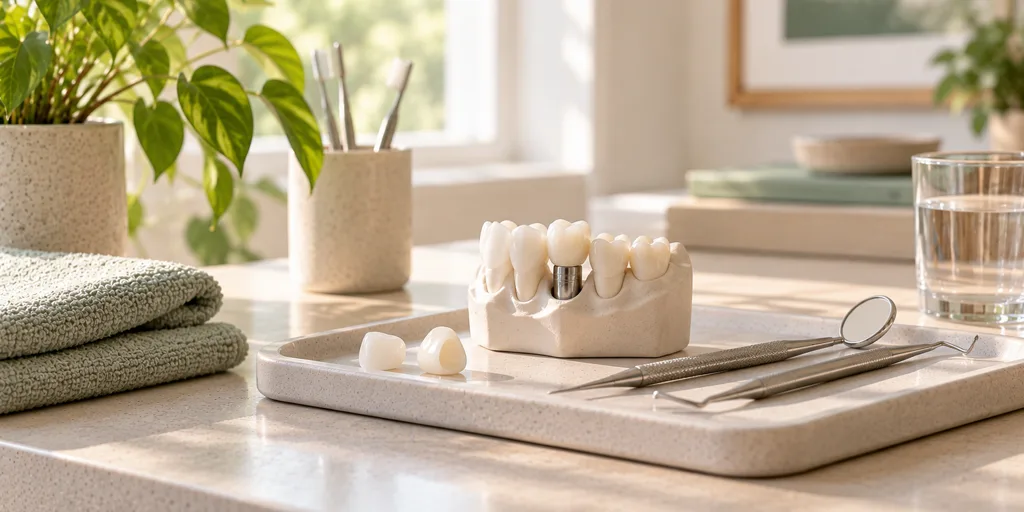
Crowns are quoted with confident lifespans and the confidence is rarely earned. The research gives a clearer picture, and it contains one finding most patients are never told: the most common reason a crown fails has little to do with the crown.
The numbers
At five years, survival is high across the materials in common use. Systematic reviews report figures in the region of 98.5 percent for monolithic lithium disilicate, 97.3 percent for veneered zirconia, 97.1 percent for metal ceramic and 96.8 percent for monolithic zirconia. Older reporting for conventional metal ceramic crowns sits around 94.7 percent.
At ten years the picture changes more than people expect. Pooled ten-year survival for zirconia and lithium disilicate crowns has been reported in the region of 79 to 82 percent, with cumulative survival across materials around 81 percent.
Read that gap properly. It does not mean a fifth of crowns break at ten years. It means that across a decade, roughly one in five needed replacing for some reason, and the reasons are worth knowing because several of them are yours to influence.
The finding that matters most
Across the reviews, secondary caries is the most frequent cause of failure, ahead of chipping of the ceramic.
Secondary caries means new decay at the margin where the crown meets the tooth. The crown itself is inert and cannot decay. The tooth underneath it very much can, and the join between the two is exactly where plaque collects if cleaning is not thorough.
So the most common failure is not the crown giving up. It is the tooth beneath it decaying while the crown sits there, intact, hiding the problem from view until it is advanced.
That has a direct practical consequence. A crown is not a reason to stop worrying about that tooth. It is a reason to clean around it carefully and keep attending check-ups, because decay under a crown is far harder to spot yourself than decay on an open surface.
What else ends a crown
Chipping and fracture
The second most common cause. Which failure you are likely to see depends on the material: glass ceramics tend to fail by fracture of the restoration, while zirconia framework failures tend to be biological or technical rather than the framework breaking.
Construction matters here. Monolithic crowns, milled from a single block, show significantly fewer ceramic fractures and less chipping than veneered ones, where a layer of cosmetic porcelain is applied over a strong core and that outer layer can chip away.
The tooth underneath
A crown depends on what it is cemented to. A heavily filled or root-treated tooth has less structure left, and a crown cannot compensate indefinitely for a foundation that is running out. This is why the tooth's condition before the crown is made is a better predictor than the material chosen.
Bite and grinding
Force is cumulative. Habitual grinding loads a crown thousands of times in ways ordinary chewing does not, and it is one of the more preventable contributors. If you grind, that is a conversation to have before the crown is made rather than after it chips.
Gum recession at the margin
As gums recede, the crown margin can become exposed. That is both a cosmetic issue and a practical one, because root surface decays more readily than enamel.
What actually extends the life of a crown
- Clean the margin properly. Given that decay at the margin is the leading cause of failure, this is not generic advice, it is the single highest-value habit.
- Keep check-ups. Decay under a crown is not visible to you and is often not painful until late.
- Deal with grinding. A nightguard is cheaper than a remake.
- Treat gum disease. The crown's margin is only as protected as the gum around it.
- Do not use your teeth as tools. Ceramic tolerates chewing. It tolerates bottle caps and packaging poorly.
Crowns are often placed after root canal treatment, because a root-treated tooth is more brittle and needs protecting. If that is your situation, we covered what that treatment involves in does a root canal hurt, and there is more on root canal treatment at the clinic.
Frequently asked questions
How long does a dental crown last?
Systematic reviews report five-year survival in the mid to high nineties across common materials, and around 80 percent at ten years. Individual results vary with the tooth underneath, your bite and how well the margin is kept clean.
What is the most common reason crowns fail?
New decay at the margin where crown meets tooth, ahead of chipping of the ceramic. The crown cannot decay, but the tooth it is cemented to can.
Can you get a cavity under a crown?
Yes, and it is the leading cause of crown failure. It is also harder to detect early because the crown hides it, which is the practical argument for regular check-ups rather than waiting for symptoms.
Is zirconia better than metal ceramic?
Reported survival at five years is broadly similar across these materials. The more meaningful difference in the research is between monolithic crowns and veneered ones, where monolithic designs show fewer chips and fractures. The right choice also depends on where the tooth sits and how it looks.
Does a crowned tooth still need flossing?
Yes, particularly at the margin. That junction is exactly where the most common failure begins, so it is the last place to skip.
What happens when a crown fails?
It depends on why. A chipped crown may be repairable or need replacing. Decay underneath means treating the tooth first, and how much sound tooth remains determines whether a new crown is possible.
Individual results vary. This article is general information, not a diagnosis or treatment plan.
If a crown is loose, sensitive or catching floss, call the clinic on +91 94540 59725 or message on WhatsApp at +91 72900 53530, Monday to Saturday, 10 am to 2 pm and 5 pm to 8 pm.