Implant or Bridge for One Missing Tooth?
When one tooth is missing and the teeth either side are present, there are two fixed ways to fill the gap: a dental implant or a bridge. Both are well established, both are fixed in place, and both can look and work like a natural tooth.
They are not the same decision, though. An implant replaces the tooth on its own. A bridge borrows support from the teeth beside it. Most of what follows comes back to that one difference. If you mainly want to know about cost, the implant cost guide covers it; this article is about the choice itself.
The two options, in plain words
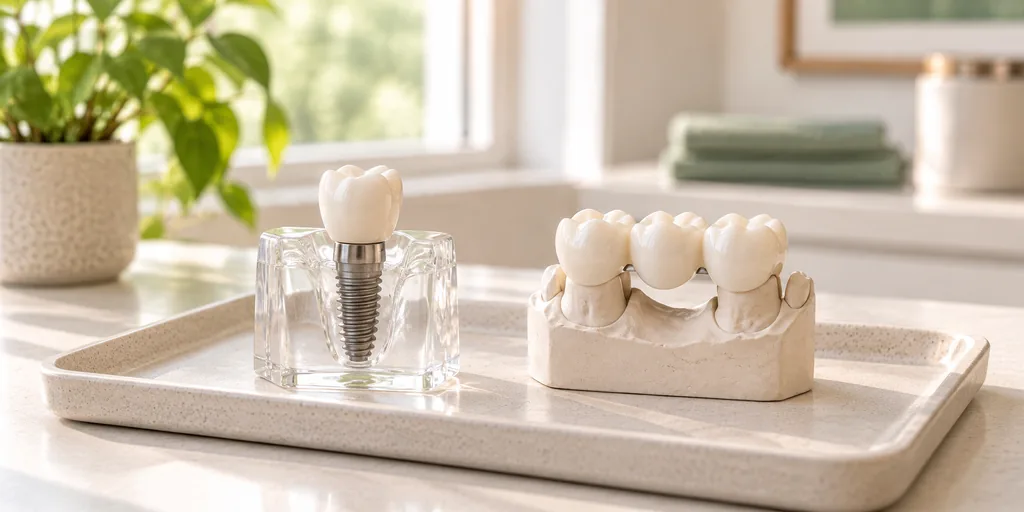
A dental implant is a small titanium post placed in the jawbone where the root used to be. Once the bone has healed around it, a crown is fixed on top. The teeth on either side are not touched.
A conventional bridge is a row of joined crowns. The two teeth beside the gap are shaped and crowned, and a false tooth hangs between them. The neighbouring teeth carry the load of the missing one.
There is a third, more limited option: a resin-bonded bridge, sometimes called a Maryland bridge. A false tooth is attached to a thin wing bonded to the back of a neighbouring tooth, with little or no shaping of that tooth. It is mainly used for front teeth where the bite is light, and the clinic offers it when it is clinically suitable.
What each one asks of the teeth beside the gap
This is the heart of the decision.
A conventional bridge needs the teeth either side to be prepared for crowns. That means removing a layer of healthy tooth all the way round, and it cannot be undone. If those teeth already have large fillings or crowns, this matters less, because they may need crowns anyway. If they are healthy and untouched, you are trading healthy tooth structure for the convenience of a bridge.
An implant leaves the neighbouring teeth alone. The trade is a different one: a minor surgical procedure, a longer timeline, and enough healthy bone in the right place to hold the implant.
What happens to the bone
After a tooth is removed, the bone that held it gradually shrinks. A systematic review of studies in people found the ridge lost 29 to 63% of its width and 11 to 22% of its height in the first six months after extraction. [5]
A bridge sits on top of the gum and does not load the bone under the gap, so that shrinkage continues beneath it. An implant sits in the bone and may help maintain it, though it does not replace bone already lost. Where bone has already shrunk, an implant may need a bone graft first, which adds time and cost. This is one reason the planning scan matters.
What the research says about how long each lasts
The numbers below come from systematic reviews. They are not a straight race, because the studies measure slightly different things, but they give a fair picture.
- Implants with a single crown: in a review of single-tooth implants, the implants themselves survived at about 97% after 5 years and about 95% after 10 years. The crowns on top survived at about 96% after 5 years. [1]
- Conventional bridges: a review of fixed bridges followed for at least 5 years estimated survival at about 89% after 10 years. Only about 71% were free of any complication over that time. [2]
- Resin-bonded bridges: a 2017 review of 2,300 bridges estimated survival of about 91% after 5 years and about 83% after 10 years. The most common problem was the bridge coming unstuck, in about 15% over 5 years. [3]
"Survival" means the tooth replacement was still in place, not that it never needed attention. Individual results vary with your bite, gum health, any grinding habit and how well the area is cleaned.
What tends to go wrong with each
With a bridge, the weak points are the supporting teeth. Decay can start at the edge of the crowns, where it is hard to see and hard to clean, and the supporting teeth can need root canal treatment later. If one supporting tooth fails, the whole bridge is usually affected. Cleaning under the false tooth needs a floss threader or interdental brush every day.
With an implant, the main long-term risk is gum and bone inflammation around the implant, called peri-implantitis. A systematic review estimated it affects about 22% of people with implants at some point, with a milder, reversible form, peri-implant mucositis, in about 43%. [4] Smoking, uncontrolled diabetes, past gum disease and poor cleaning raise the risk. Regular check-ups and professional cleaning are part of having an implant, not an optional extra.
Neither option is maintenance-free. Each asks for daily cleaning and regular reviews, just in different places.
Time, visits and cost
A bridge is usually completed in a few weeks: one visit to prepare the teeth and take a 3D digital scan, and a second to fit the bridge, with a temporary in between.
An implant takes longer. For a single implant, the healing phase is typically 3 to 6 months while the bone bonds to the implant, before the final crown is fitted. Faster options exist for selected cases, and the planning appointment tells you which applies to you. A natural-looking temporary tooth is fitted so you are not left with a visible gap while it heals.
On cost: implants at the clinic start from ₹20,000 for the implant itself. The crown that goes on top is priced separately and quoted after examination, because it depends on the abutment (the connector between implant and crown) and the crown material, such as monolithic zirconia. A bridge is priced per tooth unit, so it depends on how many units it spans and the material, metal-ceramic or monolithic zirconia, and is also quoted after examination. The implant cost guide explains what is included and what changes the figure. You receive a written, itemised plan with every step and its cost before any treatment starts.
When each one is usually considered
These are general patterns, not a diagnosis. Only an examination, and usually an X-ray or scan, can tell which applies to you.
An implant is often the first option discussed when:
- the teeth either side of the gap are healthy and unfilled
- there is enough bone, or bone can be built up
- gum health is good and any gum disease has been treated
- you are comfortable with a minor surgical procedure and a few months of healing
A bridge is often the sensible choice when:
- the teeth either side already have large fillings or crowns, so crowning them protects them anyway
- there is not enough bone for an implant and grafting is not wanted
- medical reasons make surgery less advisable
- you want the gap filled in weeks rather than months
A resin-bonded bridge may suit: a front tooth with a light bite, and younger patients for whom an implant is not yet appropriate.
Who does the work at the clinic
Every implant at the clinic is planned and placed by Dr. Saket Gaurav himself. Before any implant, a 3D CBCT scan is taken, which shows the bone and the structures around it in three dimensions so the implant can be planned precisely. Crowns and bridges are made from a 3D digital scan of your teeth rather than putty impressions.
Questions worth asking at your consultation
- Are the teeth beside the gap healthy, or would they benefit from crowns anyway?
- Is there enough bone for an implant? Will I need a graft?
- What does the full cost include for each option, crown and all?
- How long will each take, and what will I have in the gap meanwhile?
- What will looking after each one involve, day to day and at check-ups?
- If something goes wrong in ten years, what does repair or replacement involve?
A good plan answers all of these before anything starts.
Frequently asked questions
Is an implant better than a bridge?
Not for everyone. An implant leaves the neighbouring teeth untouched and has strong long-term survival in research, but it needs surgery, healthy bone and a few months. A bridge is quicker and avoids surgery, but it relies on crowning the teeth either side. The better choice depends on those teeth, your bone and your health.
How long does a dental bridge last?
Systematic reviews estimate about 89% of conventional bridges are still in place after 10 years. [2] How long yours lasts depends largely on the health of the supporting teeth and how well they are cleaned.
Does getting an implant hurt?
The implant is placed under local anaesthetic. Most people report soreness and some swelling for a few days afterwards, managed with ordinary painkillers. Our article on implant recovery covers what is normal. Individual experiences vary.
Can I get a bridge if I already have an implant elsewhere, or the other way round?
Yes. The choice is made for each gap separately, based on the teeth and bone around it.
Do I need to replace a missing tooth at all?
Not always. Some gaps, especially at the very back, cause no problems and some people choose to leave them. Your dentist can tell you whether the gap is affecting your bite or the teeth nearby, and you can decide from there.
Individual results vary. This article is general information, not a diagnosis or treatment plan.
To ask which option suits your gap, message the clinic on WhatsApp at +91 72900 53530, Monday to Saturday, 10 am to 2 pm and 5 pm to 8 pm.
Sources
- Jung RE, Zembic A, Pjetursson BE, Zwahlen M, Thoma DS. Systematic review of the survival rate and the incidence of biological, technical, and aesthetic complications of single crowns on implants reported in longitudinal studies with a mean follow-up of 5 years. Clin Oral Implants Res 2012;23 Suppl 6:2-21. https://pubmed.ncbi.nlm.nih.gov/23062124/
- Tan K, Pjetursson BE, Lang NP, Chan ES. A systematic review of the survival and complication rates of fixed partial dentures (FPDs) after an observation period of at least 5 years. III. Conventional FPDs. Clin Oral Implants Res 2004;15:654-666. https://doi.org/10.1111/j.1600-0501.2004.01119.x
- Thoma DS et al. A systematic review of the survival and complication rates of resin-bonded fixed dental prostheses after a mean observation period of at least 5 years. Clin Oral Implants Res 2017;28:1421-1432. https://doi.org/10.1111/clr.13007
- Derks J, Tomasi C. Peri-implant health and disease. A systematic review of current epidemiology. J Clin Periodontol 2015;42 Suppl 16:S158-171. https://doi.org/10.1111/jcpe.12334
- Tan WL, Wong TLT, Wong MCM, Lang NP. A systematic review of post-extractional alveolar hard and soft tissue dimensional changes in humans. Clin Oral Implants Res 2012;23 Suppl 5:1-21. https://pubmed.ncbi.nlm.nih.gov/22405099/